Your car’s dashboard warning lights are its way of communicating that something is wrong with your vehicle thus play a critical part of your car’s safety system. In this guide, we get to decode the most common warning lights, what each symbol means and what should one do when they start illuminating.
Decoding Car Dashboard Lights by Color
These lights come in different colors, with each tied to its own specific meaning.
- Green Dashboard Lights
Green lights indicate that the system is on or working correctly.
- Amber or Orange Dashboard Lights
Yellow or orange lights indicate that there is something wrong that needs to be checked but it is not a serious problem. E.g., a yellow light may indicate that the oil level is low.
- Red Dashboard Lights
Red lights indicate a serious, potentially dangerous problem that needs to be addressed immediately. E.g., a red light may indicate that the battery is not charging or a fault is present.
Here’s a quick cheat guide.
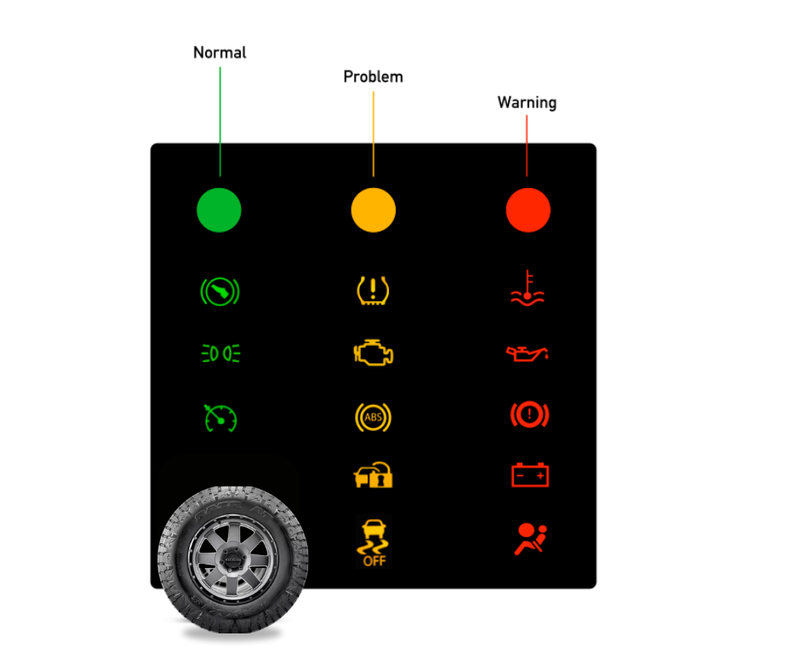
8 Common Dashboard Lights and What They Mean
- Battery Warning Light; This light often signals that the battery is low or that there is a problem with the charging circuit. As such, If this light comes on, you may need to turn off non-essential electronics, have your battery or alternator tested and replaced. This is all in a bid to avoid a dead engine.
- Oil Pressure Warning Light; This car dashboard light indicates that the oil pressure is low, of which when left un-attended could result to the engine seizing up. If the red light comes on, pull over and check the oil level; If the oil level is low, top up.
- Engine Warning Light; Symbolized with an amber or yellow engine icon. When the orange light comes on, it implies, there’s a detected issue that requires your car to be checked by a mechanic as soon as possible. More often it’s as a result of loose gas cap, or misfiring cylinders.
- Engine Temperature Warning Light; When this thermometer or wavy lines icon comes on it implies that the engine is overheating. As such it’s highly recommended you pull over and turn off the engine to cool for at least 15-20 minutes. You may also need to check for the levels of the coolant reservoir, inspect for leaks, radiator blockages or a failing thermostat. Driving with an overheated engine can cause serious damage to the engine
- Low Fuel Warning Light; The gas pump icon is an indicator that your tank in nearing reserve. As such refuel at the next safe opportunity
- Traction Control Warning Light; Symbolized with an icon of a car skidding. This is an indicator that the traction control system is not working properly. Traction control helps to prevent your car from losing traction on slippery surfaces. A car with skid marks indicates lost in traction or the stability control is deactivated or faulty. If this light comes on, you may need to have the traction control system repaired
- Brake Warning Light; When the red light comes on the icon with an exclamation point inside a circle or the word ‘brake’ this often signifies that there is a problem with the brake system. Possible reasons could be: low brake fluid, or worn pads. The best course of action ought to be stop the car and not drive further until the problem is fixed.
- Tire Pressure Warning Light (TPMS); This light signaled by an exclamation mark inside a horseshoe indicates that one or more tires are low on air.
Next steps would be to pull over and check the tire pressure or inspect for punctures and lastly inflate the tire to the manufacturer’s specifications to prevent a blowout.
Summary
It is so important to familiarize yourself with the car dashboard warning lights in your car; by doing so, you then have a clear picture of the issue with your vehicle.
In the same breadth, if unsure or need the problem resolved by a trusted technician, we highly recommend visiting any of our branches countrywide.